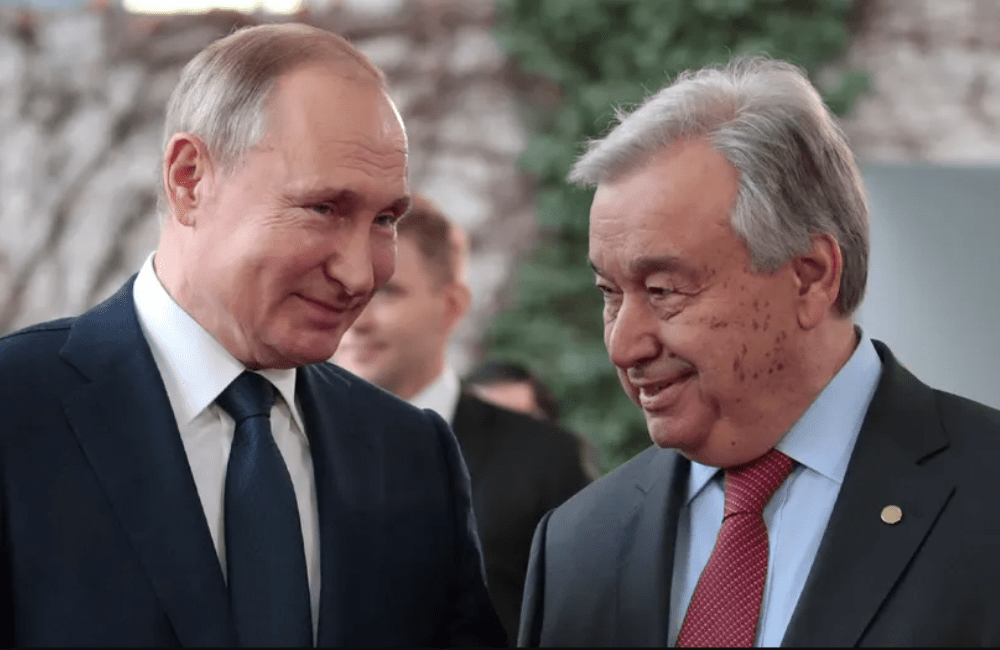
In a world increasingly divided by conflict and ideology, diplomacy remains both a necessity and a lightning rod for criticism. Few recent events illustrate this better than UN Secretary-General Antonio Guterres’s controversial attendance at the 2024 BRICS summit in Kazan, Russia. Writing for Australian Outlook, a journal of the Australian Institute of International Affairs (AIIA), opinion writer Daniel Raynolds dissects this contentious episode with nuance and insight, revealing the fault lines running through international diplomacy today.
Raynolds’s article in Australian Outlook probes the global backlash against Guterres’s decision to engage directly—and cordially—with Russian President Vladimir Putin at the October summit. Critics view this as a betrayal of the United Nations’ moral compass, especially amidst Russia’s ongoing aggression in Ukraine. Others defend it as a pragmatic step in maintaining open channels for peace.
A Summit, a Shake-Up
The core of the controversy, as Raynolds reports for Australian Outlook, lies in perception. Guterres’s presence in Russia was seen by many as a tacit endorsement of a regime that has not only invaded a sovereign nation but is also accused of war crimes by the International Criminal Court (ICC). The BRICS summit became a stage not just for geopolitical positioning, but for an international debate about diplomacy’s ethical boundaries.
Alexander J. Motyl, a professor at Rutgers University-Newark, harshly criticized the Secretary-General’s actions in an article quoted by Raynolds. Motyl called the meeting with Putin morally indefensible, arguing in The Hill that such engagements risk legitimizing autocrats and diminishing the UN’s credibility. With North Korean troops reportedly joining the Russian war effort in Ukraine, this meeting struck many as dangerously tone-deaf.
The Case for Engagement
But not all voices are in condemnation. Raynolds, in his article for Australian Outlook, highlights the perspective of geopolitical analyst and columnist Bahauddin Foizee, who offers a more pragmatic take. Foizee contends that the role of the UN is not to draw moral red lines but to keep dialogue open, even with regimes accused of heinous actions. For him, excluding Russia from multilateral talks could backfire, making peaceful resolutions even more elusive.
This defense extends to Guterres’s decision to skip Ukraine’s peace summit in Switzerland earlier in the year. According to Foizee, attending the Swiss summit would have aligned the UN too closely with Western powers, thereby compromising its impartiality. For Guterres, balance—even if perceived as moral ambiguity—was a strategic imperative.
Voices from the Frontlines
Raynolds also draws attention to the visceral reactions from those directly impacted by the conflict. Ihor Petrenko, a Ukrainian journalist, lambasted Guterres for undermining Ukraine’s sovereignty and the credibility of the UN by meeting with Putin. His criticism, as reported by Raynolds in Australian Outlook, reflects a deep sense of betrayal, especially as Guterres failed to challenge Putin’s minimizing rhetoric that reduced the war to a “family quarrel.”
Similarly, Lithuania’s top officials were scathing in their assessment. Prime Minister Ingrida Šimonytė and Foreign Minister Gabrielius Landsbergis accused Guterres of moral inconsistency. They questioned his integrity and even suggested that he consider stepping down if he cannot uphold the UN’s principles in practice. Raynolds captures the rising tension in Eastern Europe, where symbolic gestures carry heavy geopolitical weight.
Identity Crisis for the UN !
At the heart of Raynolds’s analysis in Australian Outlook is a larger existential question: What is the UN’s role in the 21st century? Is it to act as a moral judge, or a platform for continuous, and often uncomfortable, dialogue? Guterres’s actions, interpreted through these opposing lenses, either betray the UN’s foundational ideals or embody its pragmatic mission to maintain peace through engagement.
This dichotomy—moral clarity versus diplomatic engagement—exposes the precarious position international organisations occupy in a world fractured by war, populism and authoritarian resurgence. Raynolds skillfully underscores this tension, emphasizing that diplomacy is no longer viewed as neutral ground but as a potential endorsement of the status quo.
Diplomacy in the Balance: Principle vs Pragmatism
Daniel Raynolds’s article in Australian Outlook does not offer simple answers. Instead, it invites readers to grapple with the uncomfortable truth that diplomacy, particularly at the global level, often involves navigating moral grey zones. The debate over Guterres’s actions may be specific to the BRICS summit, but the questions it raises will echo well into the future: Can peace be brokered without compromise? Can dialogue exist without perceived betrayal?
As the war in Ukraine grinds on and the global order continues to evolve, the decisions made by Guterres and future UN leaders will be scrutinized for both their ethical grounding and geopolitical effectiveness. Raynolds’s piece is a timely reminder that diplomacy, like justice, is not always black and white—but it remains essential.
 Britain Politics
Leave a comment